Your express stop for the latest Sound Transit news

Growth beyond transit
The heart of Sound Transit’s mission is to provide the people of the Puget Sound region with an effective, affordable, and reliable public transportation system.
As our system expands, more and more people are familiar with the agency and recognize our trains, light rail vehicles, and buses.
Sound Transit operates as more than a public transportation agency; we’re also environmental stewards and landscaping specialists!
Beyond concrete, steel rails, trains, and buses — we’re passionate about trees, greenery, environmental protection, beautification, and restoration in the communities we serve.
Let’s look at Sound Transit’s sustainable practices.
Sustainability
Sound Transit supports people, planet, and prosperity by providing affordable, environmentally friendly public transit that connects communities to where they live, work, and play. In practice, we do this by:
- Replacing thousands of daily car commutes with transit rides.
- Supporting healthy and sustainable regional growth.
- Fostering transit-oriented development and improved transit access.
- Designing and building greener projects.
- Operating fleets and facilities efficiently.
While our commitments mostly emphasize what we improve (reduced car trips, decreased carbon emissions, and reduced time spent in gridlock), Sound Transit also supports the environment through what we contribute. We protect and enrich the biodiversity and green spaces in our region through new landscaping, wetland protection, and environmental restoration.
Landscape planning
We spoke to Sound Transit Principal Landscape Architect, Mark Epstein, to learn more about Sound Transit’s processes around trees and environmental restoration. Epstein explains that the complex nature of Sound Transit’s system and projects means that its approach to landscaping is never one-size-fits-all.
Rather, Sound Transit creates customized landscaping plans for each project and focuses on three primary components:
- General environmental restoration.
- Station areas.
- Rail corridors between stations.
Sound Transit projects begin by working with the local governmental jurisdictions involved in the project area and neighboring communities to develop environmental plans well before any shovels hit the ground.
Epstein says that by starting this process early, Sound Transit and its partners can account for the full extent of possible environmental impacts, gather public feedback, and make improvements through multiple rounds of design review.
These steps help Sound Transit develop comprehensive plans to preserve and enhance the environment as much as possible during the construction process.
Sound Transit commits to planting new trees and vegetation as part of our projects to provide benefits for future generations.
Restoration projects
Sound Transit’s restoration of Scriber Creek Lynnwood City Center Station is one great example of our commitment to environmental restoration during the construction of our Capital Projects.
Sound Transit collaborated with the City of Lynnwood and the Washington State Department of Transportation (WSDOT) to incorporate extensive environmental restoration and landscaping into the Lynnwood City Center Station design.
During the design process, the project team learned that decades ago, a nearby creek was routed into pipes and completely covered under asphalt near the Lynnwood Transit Center.
Together, the parties involved recognized an opportunity to daylight Scriber Creek as part of the construction of Lynnwood City Center Station. All three partners and Sound Transit’s construction contractor worked together to uncover this creek and restore the aquatic and plant life native to the area.
The plan succeeded, and now Scriber Creek runs open to the sky between I-5 and the station, and new plant life is already flourishing.
This effort is one of the many reasons why the Lynnwood City Center Station received LEED Gold certification from the US Green Building Council.
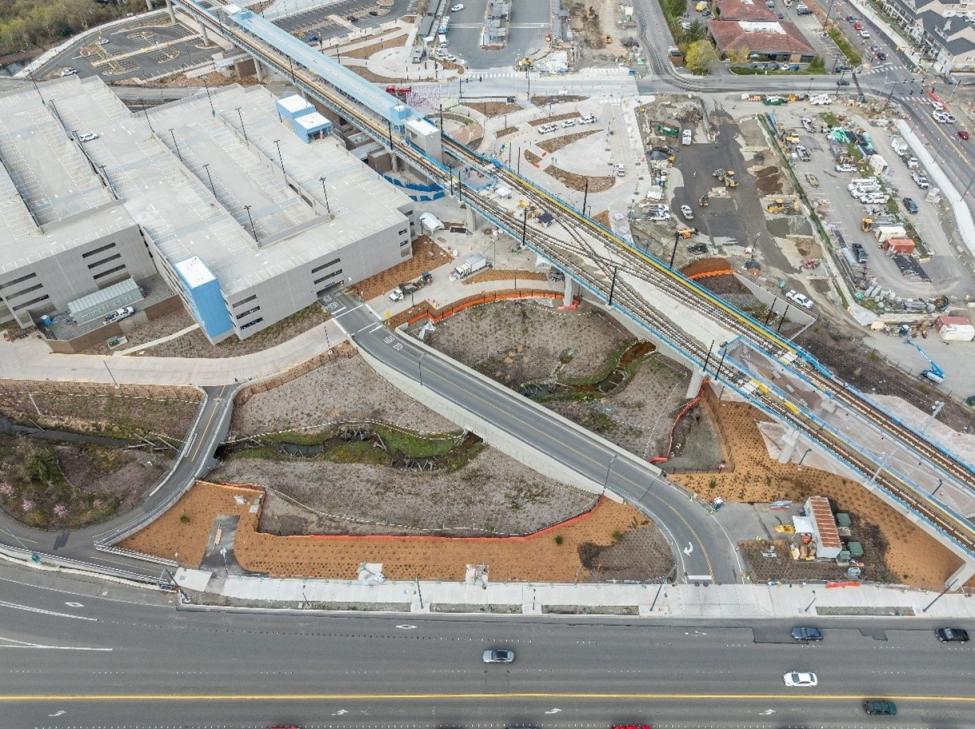
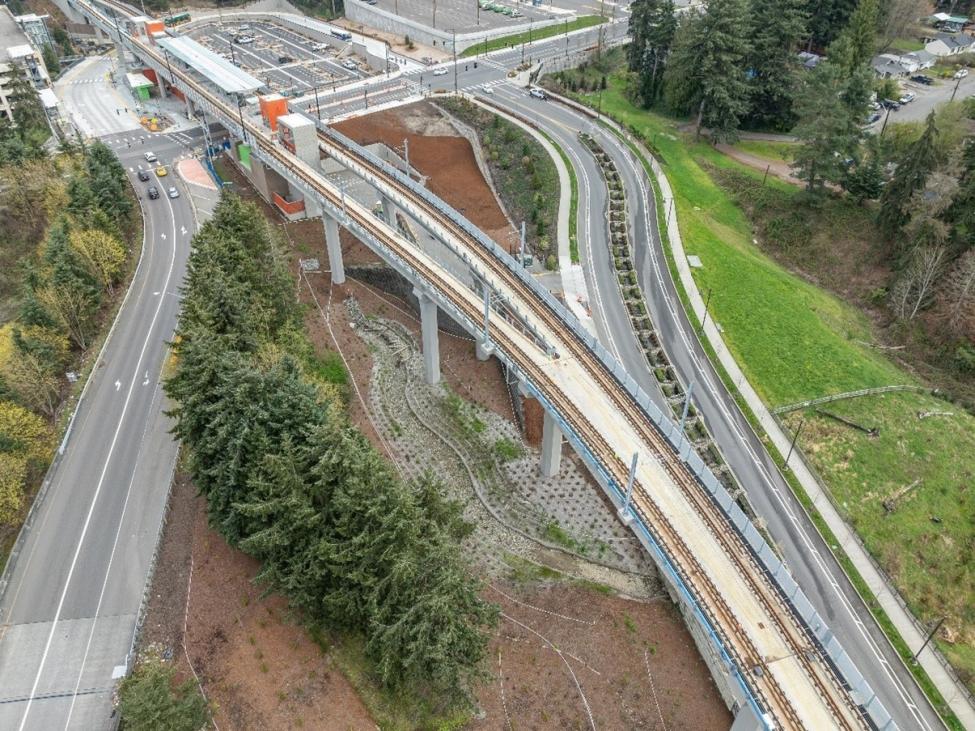
Mountlake Terrace Station is another example of Sound Transit’s commitment to restorative landscaping. Construction of the station and the tracks on each side required substantial tree removal. With a smaller station area and elevated tracks, crews had limited space. The project team had to be mindful about what trees to plant and where.
Sound Transit had to remove trees during construction but planted three times as many trees at appropriate areas along the alignment to offset the removals. Crews also planted shrubs and other vegetation underneath the tracks and in areas that had been cleared during construction.
There are times when the project design and surrounding area make it too difficult to restore the environment next to stations or tracks. In these situations, Sound Transit works with neighboring communities and local governments to find ways to support tree planting, environmental restoration, and landscaping improvements outside project limits to make sure we’re meeting our sustainability goals and commitments.
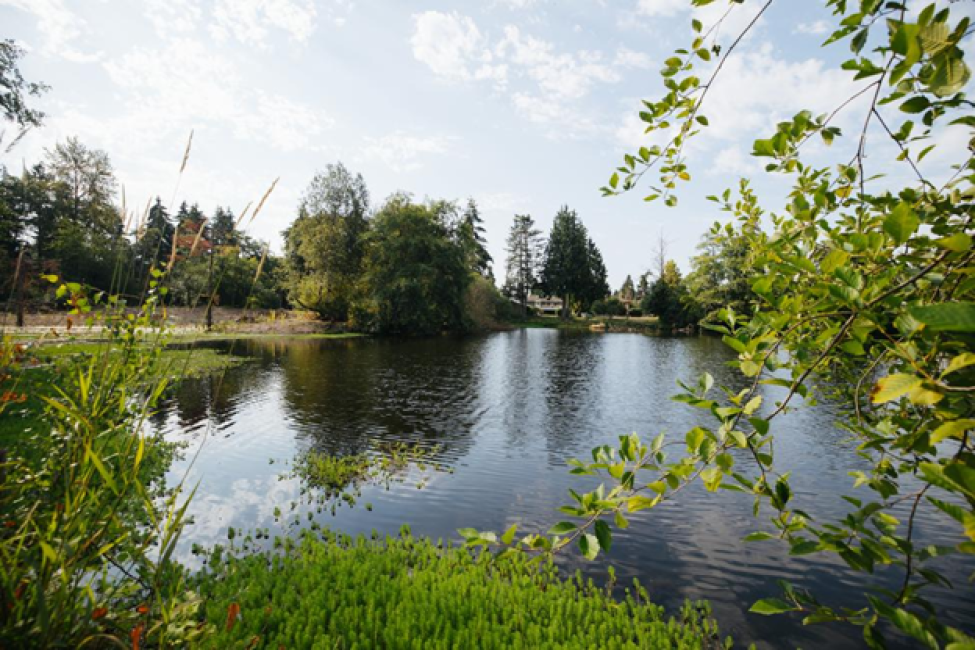
Sound Transit recently completed such work at the Ronald Bog Park in Shoreline. We spent much of 2019 and 2020 improving the park as part of our mitigation for impacts caused by construction on the Lynnwood Link Extension. Crews started by removing overgrown invasive plant species, trash, debris, and contaminated soil.
Once clear, crews added over 7,000 cubic yards of healthy topsoil, planted over 28,000 native plants, and increased the flood capacity of the area by over 2 million gallons. Four years later, Ronald Bog Park is thriving.
Project spotlight: Stride Bus Rapid Transit
Sound Transit is currently developing a new bus rapid transit (BRT) service called Stride that will start operations in 2028 and 2029.
Stride BRT is a high-capacity transit system serving communities surrounding Lake Washington and connecting them to Link light rail and other transportation services. The work associated with building Stride demonstrates Sound Transit’s commitment to a green future.
The Stride S1 Line will connect communities along I-405 and SR 518 from Bellevue to Burien. Stride S2 Line will connect communities along I-405 and I-5 from Bellevue to Lynnwood. Stride S3 Line will connect growing north Lake Washington communities from Shoreline and Seattle to Bothell.
As a regional program, Stride will operate over long distances and through environmentally sensitive areas.
Across the Stride S3 Line corridor, project teams have carefully planned to protect existing trees and native habitats before, during, and after construction. When trees and vegetation must be removed, we will restore the tree canopy where it was lost and add new landscaping that accounts for permanent changes for transit improvements.
Through regular meetings with city officials, residents, and property owners, Sound Transit has addressed numerous concerns raised by the public and has tailored design and construction plans to minimize effects on the natural environment. Some examples include:
- Reducing the number of trees slated for removal.
- Altering the alignment of the Burke-Gilman Trail to avoid existing trees.
- Creating a customized retaining wall design that supports long-term plant growth.
When all construction and landscaping is completed, Stride passengers will enjoy a beautiful view of plant and tree life out the bus window.
Join us as we Stride into a greener future!