Your express stop for the latest Sound Transit news

Crosslake Update: Making the I-90 bridge safer for fish
Find out how Sound Transit has been working with agency and Tribal partners to protect Lake Washington’s aquatic life.
Last week, professional scuba divers began installing a new feature below the 2 Line’s Crosslake Connection: slim mesh cages designed to protect fish around the I-90 floating bridge.
These tubular cages surround anode strings — the underwater wires connected to floating pontoons that emit electrical current to prevent corrosion of the steel and concrete.
Sound Transit developed the mesh cage design in consultation with WSDOT, fisheries staff from the Muckleshoot Indian Tribe, and the Washington State Department of Fish and Wildlife as a pilot solution after being alerted to an unusual number of dead fish on the lakebed near some of the bridge anodes this summer.
After WSDOT alerted Sound Transit of this issue on Aug. 3, we began working with government and Tribal partners immediately to deploy divers, biologists, and engineers to investigate.
The testing these experts recently completed confirmed that anode strings, which are part of the bridge’s cathodic protection system, could be at fault.
Anodes are designed to emit a low-level electrical current. But after testing the water, lakebed soils, and the anode strings themselves for factors that might be affecting fish, we found the electric fields in close proximity to the anodes — specifically, within about six inches — to be higher than anticipated.
By Aug. 23, Sound Transit crews had completed work to lift anode strings that had been resting on the lakebed and stunning fish. We saw immediate improvement after these adjustments, and we expect the further work we’re undertaking now to fully resolve the anode current issue.
That includes installing 13 mesh cages, which use readily available, off-the-shelf materials commonly employed in aquaculture. We’ve added underwater cameras to monitor the cages, and we’ll continue with frequent dive inspections to monitor their effectiveness.
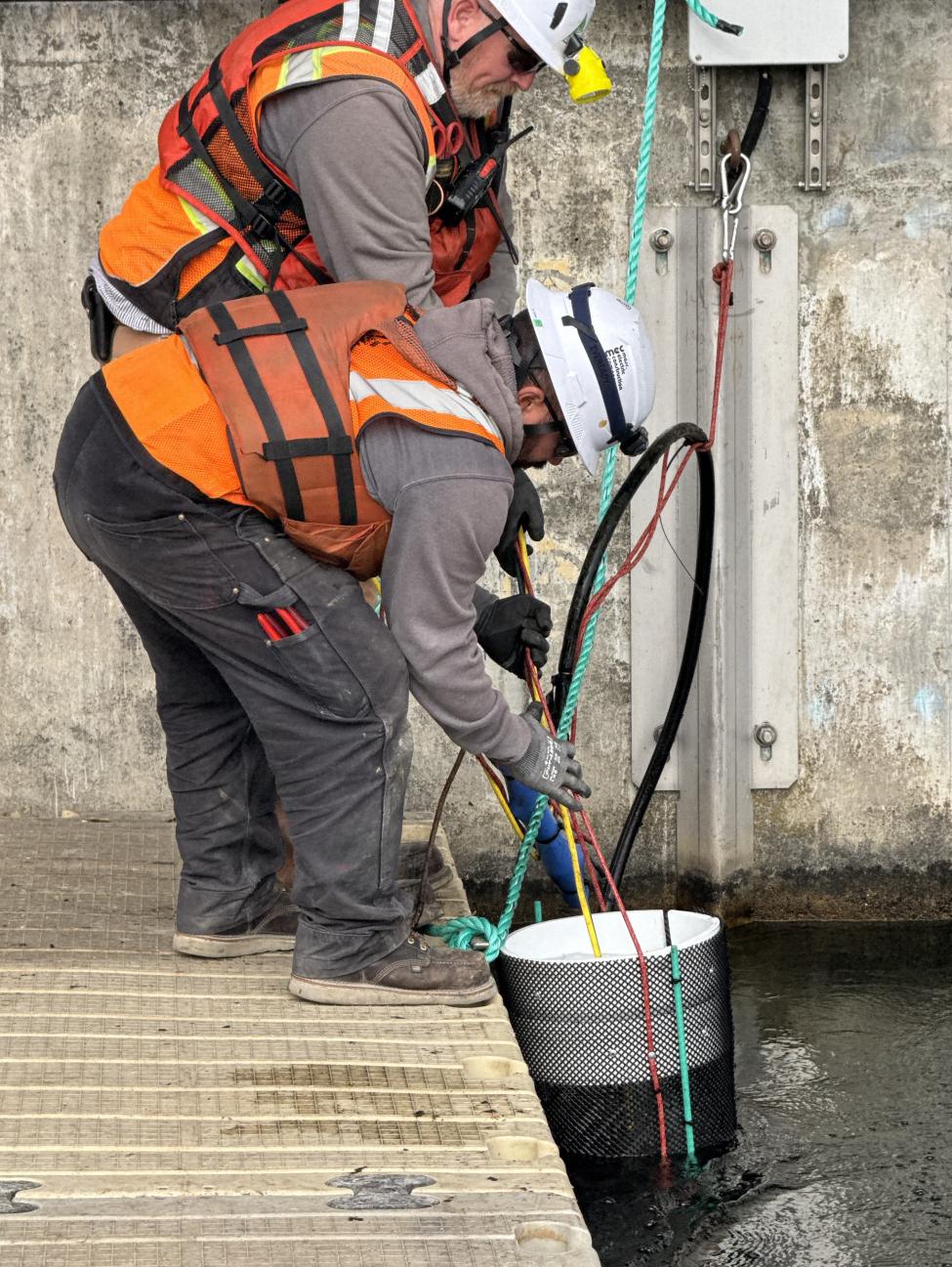
If the 13 cages perform as expected, we will immediately move forward with installing them across all 136 pontoon anode strings on the bridge.
In the meantime, Sound Transit will remain closely aligned with our local, state, federal, and Tribal partners as we institute a long-term monitoring and inspection program. Public transit offers tangible environmental benefits for our region’s growing communities, and we’re deeply committed to conserving and improving our natural environment for generations of future Puget Sound residents.