Your express stop for the latest Sound Transit news

Next steps on the Ballard Link Extension
Opening the full extension all the way to Market Street is possible by 2042. Here’s what it will take.
On May 28, the Sound Transit Board adopted an updated ST3 System Plan to bring the agency’s long-term financial outlook into balance. The process required difficult choices after a year of work by the Board and Sound Transit staff to address a projected $35 billion funding gap over the next quarter century.
The updated plan represents significant progress for the region and keeps every ST3 light rail extension moving forward.
It also requires us to be clear about what has been funded, what remains to be done, and what it will take to complete the Ballard Link Extension to Market Street.
“The Sound Transit Board has been clear: Our commitment is to deliver the full Sound Transit 3 program that voters approved, including extending light rail all the way to Ballard,” said Board Chair and Snohomish County Executive Dave Somers. “While today’s financial realities require us to be disciplined and strategic, they do not change our commitment. By continuing design and environmental work on the full Ballard project, we’re preserving the path to complete the extension while aggressively pursuing cost savings, new funding opportunities, and every available tool to make it a reality. The Board is committed to keeping our promise to the public and delivering the full regional transit system envisioned in ST3.”
A commitment to get to Ballard
The updated plan makes a significant commitment to the Ballard Link Extension. It dedicates $18.1 billion to the corridor, funds light rail construction from Chinatown-International District to Seattle Center, and provides $300 million to complete design all the way to Market Street.
These investments keep the full extension moving forward and preserve a path to completing the line to Ballard.
The Board, transit riders, and the public have made it clear that building the full Ballard line to Market Street is a top priority. The plan keeps the full project moving forward while Sound Transit works to reduce costs, expand financial capacity, and secure the remaining funding needed for construction beyond Seattle Center.
Continuing design now puts the region in the strongest position to identify savings, pursue additional funding, and deliver light rail to Market Street as soon as possible.
“As a Board and an agency, we are united in our commitment to deliver the full Ballard Link Extension and all voter-approved ST3 projects,” said Boardmember and King County Executive Girmay Zahilay. “The information provided by Sound Transit today shows we can deliver light rail to Market Street in 2042 if we stay focused over the next seven years on finding cost savings and additional financial capacity. I’m ready to do everything in my capacity as a Board member and regional leader to make this happen.”
Maintaining momentum: What we’re doing to get to Market Street
Completing the environmental process. This is a major milestone that keeps years of planning on track and moves the project closer to construction.
Finding ways to reduce costs. As the project advances, we’ll build on the $3 billion in cost savings already identified for the Ballard Link Extension project and continue refining the design and construction approach to identify additional savings.
Advancing the full extension to final design. Sound Transit has already identified $2.2-$2.6 billion in cost savings on the West Seattle Link Extension as the project has progressed toward final design. Our job is to bring Ballard Link Extension project costs down through that same process.
Pursuing additional funding. We’ll continue working with our local, state, and federal partners to identify new opportunities that can help stretch our dollars further, increase our capacity, and deliver the full extension to Market Street.
Potential additional financial capacity
Longer bond terms, which add capacity in the near-term to allow more projects to be delivered.
Increasing debt capacity, which adds overall capacity for the agency to deliver more projects.
Station area value generation, which leverages growth from development to increase agency revenue.
Third-party funding, which could be from public or private partners to build more of the Ballard project than is currently affordable.
Permitting reform that speeds project delivery, which saves time in the project schedule and reduces overall project costs.
“As a lifelong transit rider, I know how important the full build out of ST3 is to people’s lives and to our region’s future,” said Boardmember and Seattle Mayor Katie Wilson. “As your Mayor, I’m going to make sure we get it across the finish line.
“Together with my fellow Board members, Sound Transit staff, and our partners in local government, I’m confident we will find creative ways to lower costs and fund construction of the Ballard Link Extension all the way to Market Street,” Wilson continued. “As we saw this summer, a connected and convenient transit system can elevate a city and region to world-class status, and we are committed to building upon that success.”
Important milestones for the Ballard Link Extension
The full Ballard Link Extension from Chinatown-International District to Market Street could open at the same time as the fully funded segment to Seattle Center by 2042 if Sound Transit can further reduce project costs, increase financial capacity, and secure remaining construction funding.
The current system plan fully funds light rail to Seattle Center with an anticipated opening date in 2042. The schedule has shifted from 2039 because of changes to station locations, an updated construction timeline, and an extended environmental review process.
Over the next several years, we’ll continue to pursue cost savings and additional financial capacity in preparation for right-of-way acquisition on the segment between Seattle Center and Market Street.
This phase will require approximately $1 billion beginning in 2030 in additional cost savings or new capacity to make those acquisitions.
Another major milestone will be the completion of final design in 2032, by which time we’ll have an even clearer picture of the project's remaining cost and the additional savings we’ve been able to incorporate.
In order to keep the full project on schedule for a 2042 opening, Sound Transit will need to secure all necessary funding by 2033.
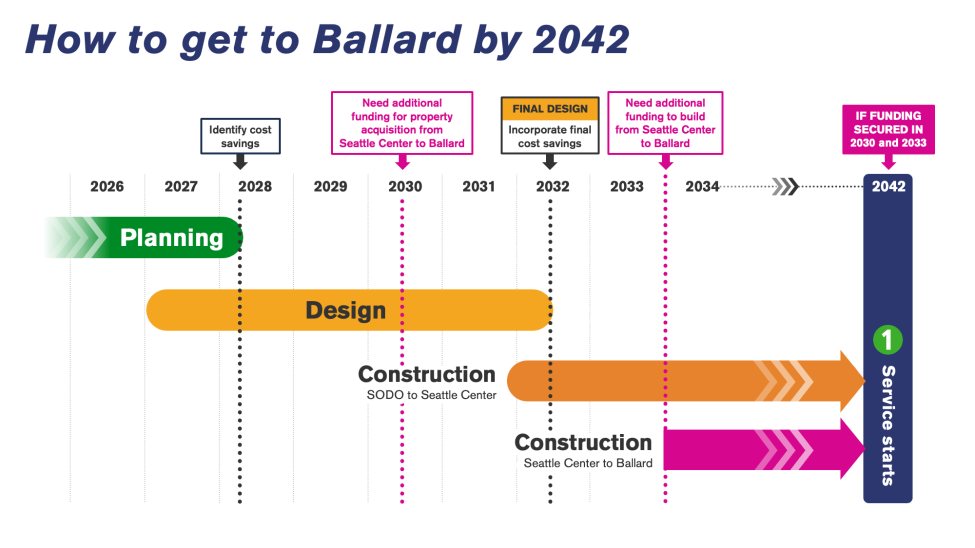
Three milestones will determine if the full extension can stay on schedule:
By 2030: Identify approximately $1 billion in additional savings or financial capacity to begin acquiring property between Seattle Center and Market Street.
By 2032: Complete final design, giving the Board a clearer understanding of the project’s cost and remaining opportunities for savings.
By 2033: Secure the funding needed to build the full extension and preserve the opportunity for a 2042 opening.
This path forward provides clear milestones to measure progress on the Ballard line. Meeting these milestones will require sustained work by Sound Transit and continued partnership with local, state, and federal leaders.
“The funding package adopted by the Sound Transit Board in May included 100% design for Ballard and amendments sponsored by North King County Board members to accelerate Sound Transit’s pursuit of cost savings, additional financial tools, and community and board accountability on Ballard light rail—including providing a date for delivering Ballard that’s accurate and informed by analysis. Today we are seeing action on those directives,” said Boardmember and King County Councilmember Teresa Mosqueda.
“The framework shared by Sound Transit provides a date that’s grounded in tangible steps for delivering all the way to Market Street,” Mosqueda continued. “The design work done on West Seattle shows what’s possible when we demand creative thinking and aggressively pursue cost-savings options: properties avoided, ridership retained, and billions saved. Now we must apply the same approach to Ballard while rolling up our sleeves with our state legislative partners to secure the needed financial tools. We will get to Ballard, and we will not stop working until we deliver on that commitment.”
The challenge ahead
If the region does not secure additional savings or financial capacity and must wait for existing revenues to accumulate, Link service to Smith Cove, Interbay, and Market Street could be delayed until around 2060.
We do not want that outcome. That’s why the work must begin now to complete environmental review, advance design, reduce costs, and identify new financial capacity.
None of these steps alone will close the gap, and meeting every milestone will be challenging. Together, however, they give us the strongest path to completing the full Ballard extension as soon as possible.
This updated plan commits to meaningful progress for Ballard and gives the region a clear set of milestones against which to measure that progress.
“Light rail to Ballard is not dead,” said Boardmember and Seattle City Councilmember Dan Strauss. “Today’s announcement shows us the way to get Ballard Link back on track. I asked for Sound Transit to provide this date range to increase transparency for the public and provide us all a clear vision of the work we must do together to deliver light rail to Ballard. We must use these tools and get this project delivered by 2042. We always knew that without additional resources or cost savings the date would be unacceptable. Now, we are unified on the work we must do to move that date sooner.”
Sound Transit is committed to following through on the Board’s direction, staying disciplined about cost control, and being transparent with the public about whether we are on course to open the full extension by 2042.
As we roll out more details on projects affected by the System Plan update and opportunities to engage, be sure to sign up for project updates, follow Sound Transit on social media, and stay tuned to The Platform blog.