Your express stop for the latest Sound Transit news

What’s the latest on light rail expansion to Ballard?
Find out what we shared at our recent community forum in Ballard, what we heard from attendees, and how we’re working to deliver light rail service to Market Street by 2042.
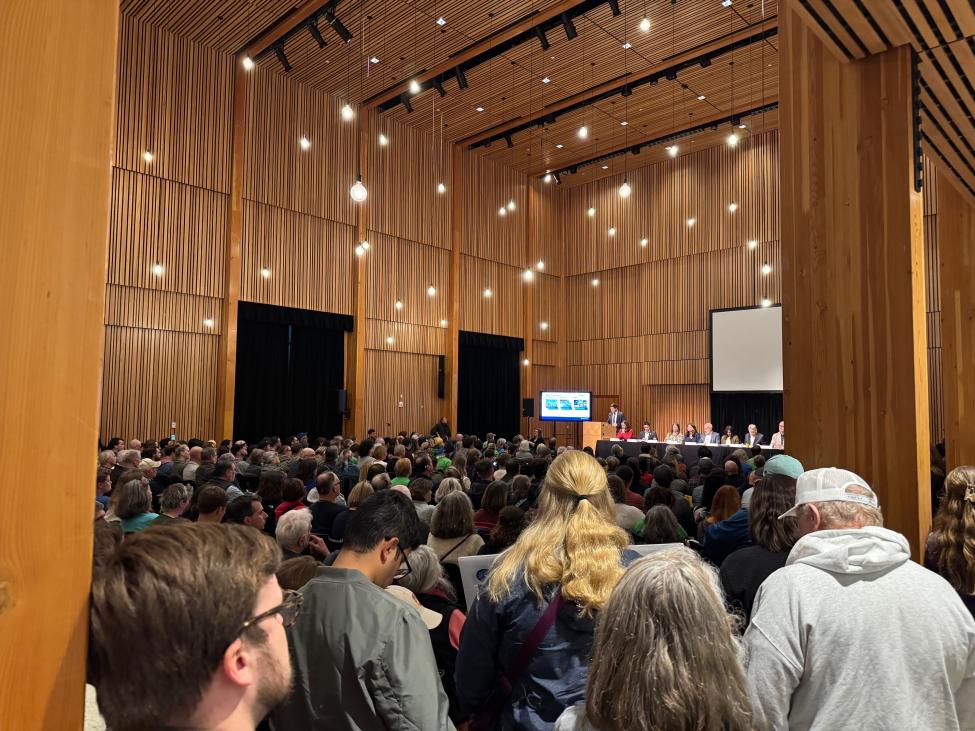
It wasn’t just locals who crowded into the National Nordic Museum for a town hall meeting about the Ballard Link Extension on Monday night, Oct. 19.
People from across the region convened to hear the latest project updates, ask questions of Sound Transit staff and local and state elected officials, and share their opinions, ideas and frustrations.
As diverse as the crowd was, everyone was united in their enthusiasm for transit and expanding Link light rail all the way to Ballard.
What we shared: The path forward
A panel of speakers including Sound Transit Board members and other elected officials welcomed attendees by affirming their commitment to helping deliver light rail to Ballard, and each representative shared actions they’re taking to accomplish that goal.
Sound Transit CEO Dow Constantine kicked off a presentation by Ballard Link Extension project leadership by reinforcing the agency’s commitment to deliver light rail service all the way to Market Street.
“We’ve identified a path to deliver the entire Ballard Link Extension by 2042,” he told the crowd of more than 325 attendees. “Will it be easy? Of course not. That path has milestones along the way. And like many paths to getting somewhere worthwhile, it has obstacles along the way.”
Sound Transit Acting Chief Capital Delivery Officer Brad Owen and Ballard Link Executive Project Director Lauren Matthias presented a roadmap for reaching Ballard, including critical milestones and strategies for closing the project’s current funding gap of $7-$9 billion through a combination of cost-saving measures and tools to increase financial capacity.
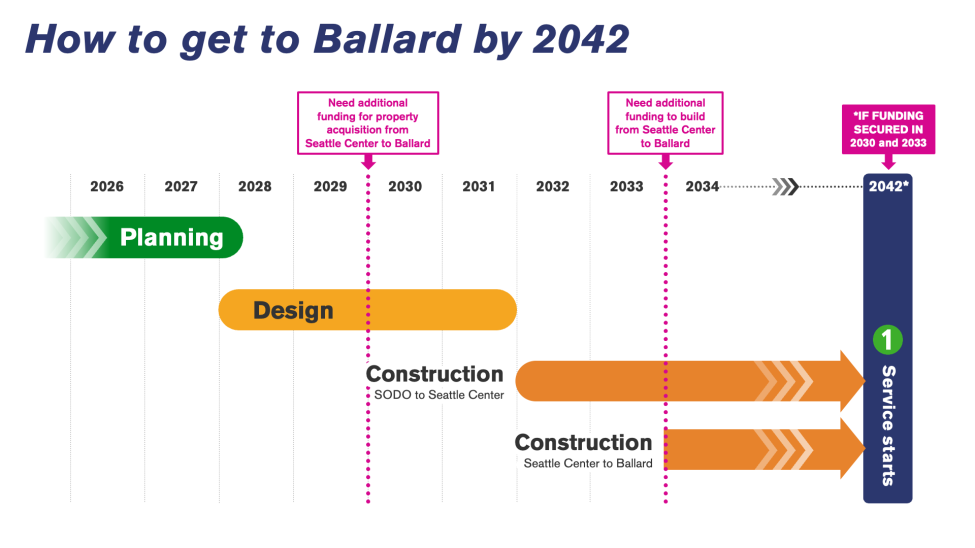
Cost-saving opportunities include:
Finding design efficiencies. We’ve already incorporated up to $4B in cost-saving opportunities, including ways to make project elements smaller and more efficient. Progressing further through the design process will allow us to identify additional savings, just as we did on the West Seattle Link Extension project.
One key milestone in this process is selecting an engineering and design services partner. Sound Transit opened this contract procurement on Oct. 15, and we expect the selected firm to begin work by mid-2027. Once this critical partner is on board, our goal is to have them identify additional cost savings within roughly 10 months.
This work will also incorporate feasible ideas generated in response to the Request for Information we issued earlier this fall seeking innovative technologies to reduce project costs and speed delivery. When we’ve finished reviewing all the RFI responses, we’ll share a summary with the Board and the public.Finding process improvements. Sound Transit and the City of Seattle have been working closely to share information and get early alignment on project design so future reviews can move quickly.
With the shared goal of shortening the project schedule, the project team, agency staff, and Board members are also working together to identify ways to simplify and shorten the permitting process and improve how the agency acquires properties.Adopting innovative construction approaches. Building on years of extensive industry engagement during the planning phase, the project team will continue to work closely with construction contractors early in the design process. This engagement will allow the Ballard Link project to incorporate cutting-edge technology and lessons learned from other projects.
Strategies for increasing financial capacity include:
New financing tools and potential debt capacity changes to increase borrowing capacity in the mid-2030s when several ST3 projects will be in the construction phase.
State and local partnerships such as station-area value capture. We plan to share more about what this might look like when we publish the agency’s first Transit-Oriented Development Strategic Plan in the coming months.
Federal grants and other policy opportunities at the local, state, and federal levels that save costs and speed project delivery.
What we heard: Light rail to Ballard is crucial
Audience members queued up to ask questions and panel members answered their questions for more than an hour.
Some people offered cost-saving ideas and wanted to know whether Sound Transit had considered them. Others were skeptical or critical of the agency’s work or simply wanted to better understand the process. The number and range of questions reflected how closely the community has been following this project and the importance of bringing light rail to Ballard.
Questions generally fell into several categories:
“Have you considered new ways to deliver the project?”
“Why isn’t Sound Transit building an elevated guideway through downtown Seattle instead of a tunnel?”
“Has the agency considered smaller stations and smaller and/or automated trains?”
“If the downtown core is the most expensive segment, has Sound Transit considered a hub and spoke model without connecting to downtown?”
Owen and Project Director Daniel Turner affirmed that the agency has considered all these options and more. They noted that the project team has already incorporated several ideas— such as smaller and more efficient stations — and that the agency is evaluating a variety of technologies to improve operations, like partial automation through communications-based train control, or CBTC.
Owen and Turner also shared that the project team has considered full automation and the possibility of an elevated alignment downtown and found that the minimal cost savings potential and/or substantial feasibility issues with both did not warrant carrying the ideas forward.
“How is Sound Transit going to find the funding?”
“Where are the $2B to $4B worth of cost savings mentioned coming from? How are you funding the rest of the gap to get to Ballard?”
“On the West Seattle Link Extension, we saw a station [Avalon] being cut. Are you considering doing that to save money on Ballard Link?”
“With the current federal administration, are federal grants being pursued?”
Panelists noted that the savings are identified in the cost-savings work plan — including station and other design efficiencies — and that we’ll be able to identify more opportunities after the Board confirms a preferred alignment for the project and design advances with the engineering and design services partner onboard.
The soon-to-be-published Ballard Link Extension Draft Environmental Impact Statement does include an option for station consolidation for the Board to consider.
Federal grants are assumed for 35% of funding for all ST3 projects, but Constantine pointed out that Sound Transit doesn’t need to apply for federal grants under the current administration.
He also reaffirmed the agency’s commitment to closing the funding gap and getting to Market Street in Ballard by 2042.
“What’s one concrete action that each person in this room can do to make light rail to Ballard a reality?”
The final question of the evening was posed to each of the panel members, who offered their takes on ways people can help move the project forward, including:
Engage in the upcoming state legislative session. Passing a 75-year borrowing bill will be critical for further advancing Ballard Link and other ST3 projects that don’t yet have guaranteed construction funding.
Be persistent in advocating for the project. You can do this by commenting on the Draft EIS when it’s published and by providing public comment at Board meetings and future community forums.
Share what you learn with your neighbors.
What happens next
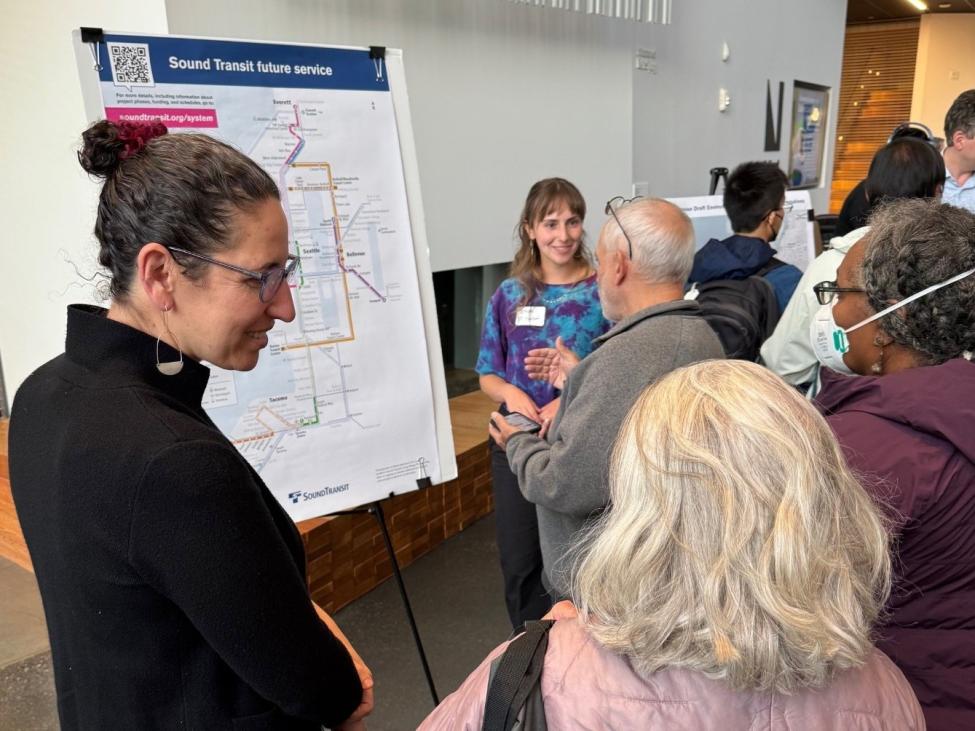
You can expect several project updates and opportunities to engage with the project team in the months to come, including:
Sharing results from our Request For Information: Project staff are finishing their review of ideas submitted to save cost and speed delivery of Ballard Link and other ST3 projects. The concepts put forward in RFI responses will be thoroughly explored with the engineering and design services consultant starting in mid-2027. We’ll share an overview of the information received with the Board and the public later this year.
Publishing the project’s Draft Environmental Impact Statement: Sound Transit staff will publish the Draft EIS on Dec. 11, with a 60-day public comment period. Learn more about what a Draft EIS includes and how Sound Transit gathers public feedback.
More community forums and open houses: Commenters at the Nordic Center forum asked for more opportunities to learn and provide comment, and we’re already working to get future forums scheduled. We’re also planning several open houses and hearings during the Draft EIS comment period, and we expect to be able to announce those dates soon.
In the meantime, be sure to stay up to date on all things Ballard Link by following Sound Transit on social media and signing up for project alerts here.
Editor’s note: This post was updated at 12:30 p.m. on Oct. 30 to reflect the Ballard Link Extension Draft EIS publication date.