Your express stop for the latest Sound Transit news

What to watch for next at Pinehurst
Pinehurst Station opened last month on Sept. 30, with a lovely celebration of community to welcome riders to Sound Transit’s first infill station and bring a new Link connection to North Seattle.
Those of you who have visited the station already may have noticed there is still some work to be done, including the final installation of a few panels and tiles on the north end of the station.
When you visit Pinehurst station, make sure to take a moment to notice the tile wall in the plaza. To make the tilework feel familiar and new, artist Romson Bustillo combined stylized and abstract images of local flora and fauna alongside more easily understood glyphs. He also added visual details to welcome and guide passengers, such as stylized cars that reflect commuting culture and repeated shapes intended to create a calm feeling or evoke a pleasant memory.
Porcelain enamel panels are installed at the station entrances and lobbies, while the completed stenciled column is located at the south entrance. Bustillo’s intention for the panels is a “dual quality” that feels both monumental and intimate: larger shapes signal a communal experience as riders approach the station, while smaller details invite a closer look as people move through different viewpoints and eye levels.
Bustillo also drew from architectural and cultural references in developing the panel compositions. He notes being reminded of communal longhouses on stilts found in Southeast Asia and incorporated forms that suggest movement and support wayfinding. Textile traditions from the Philippines — including ikat and appliqué practices — were influential in building patterned fields that can be read at multiple distances.
The stenciled column uses shapes cut from the artist’s files. Bustillo describes the column as being in dialogue with the main structure, “like a lighthouse beacon,” communicating presence and guidance from different viewpoints, with an emphasis on shapes that suggest light emanating from the column.
Bustillo and Sound Transit started coordinating fabrication and installation with the contractor two years ago so that the artwork could adapt to any station design and construction challenges and constraints. Once the full pieces are in place, details like wayfinding cues and the tile wall’s “access pictogram” will read more clearly as a unified set of artworks.
Bustillo’s artwork aims to be universally recognizable, with room for personal interpretation. His artwork is rooted in personal history and cultural markers for the artist, but will belong to and speak to everyone who passes through the station.
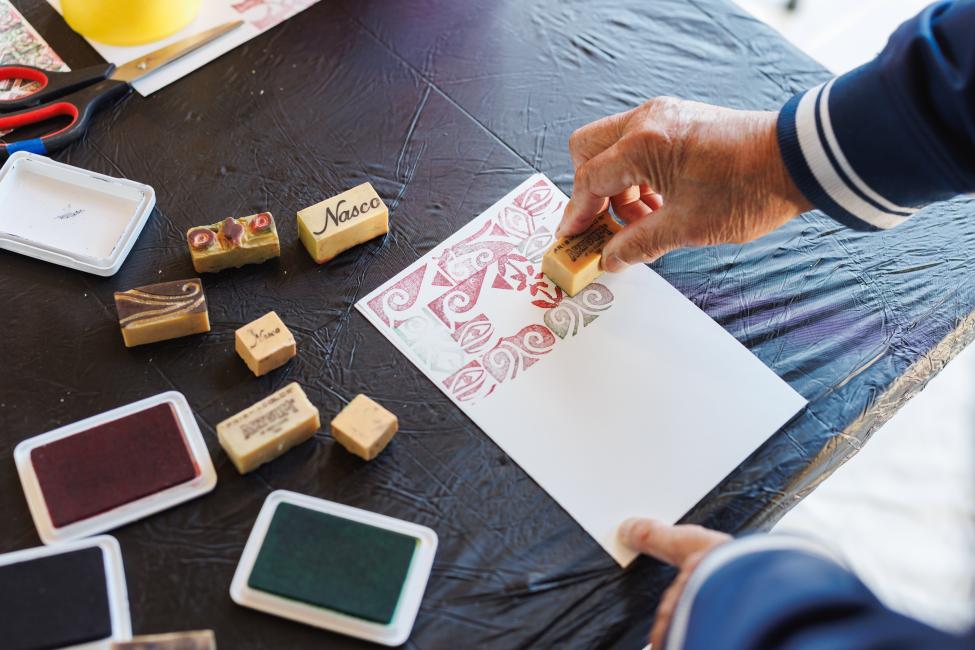
The community connection continued on opening day, when Bustillo invited visitors to participate in hands-on artmaking at the station.
It was a fitting continuation of the workshop process that helped shape the artwork in the first place: community members were again creating alongside the artist, this time surrounded by the completed station and many of the artworks those earlier conversations helped inspire.