Planning
The planning phase of Sound Transit projects consists of two different stages: alternatives development and environmental review. These steps help us ensure that we are hearing public feedback, analyzing potential options, and addressing our natural environment when building megaprojects in our region. Read on for more information about these steps in the process:
Alternatives development: 1-2 years
Starting with the representative project from the voter-approved plan, Sound Transit develops “alternatives,” or specific route and station locations to study and review.
This phase includes technical analysis, public engagement, and advisory group recommendations to narrow down options. Community members, elected officials, partner agencies, and other interest holders provide comments and help to screen for reasonable alternatives to carry forward.
Informed by this collective input, the Sound Transit Board ultimately identifies which alternatives to study. In many cases, that includes a “preferred alternative” and “other alternative(s).”
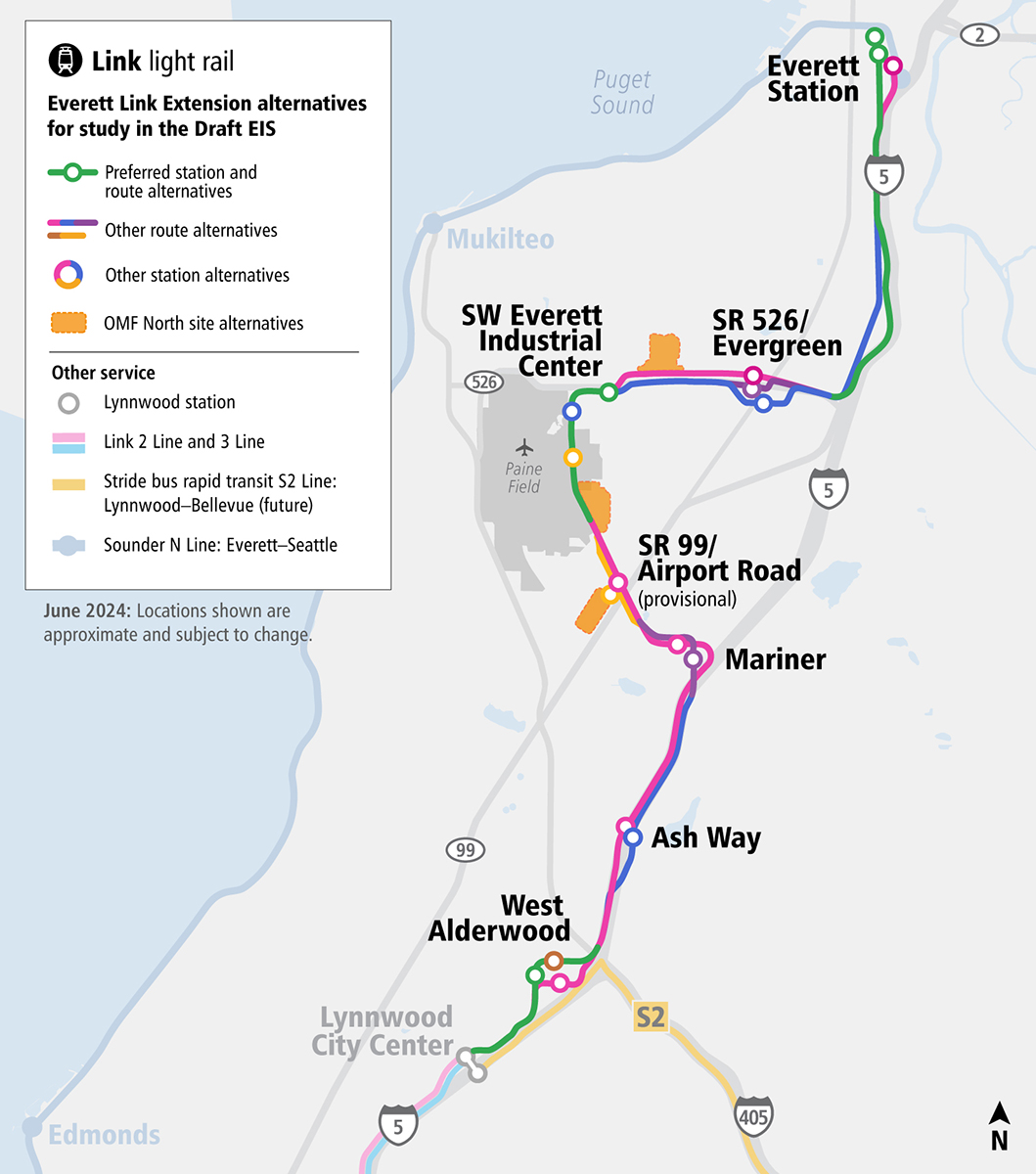
This map shows the multiple alternatives Sound Transit studied in the Everett Link Extension Draft EIS.
Environmental review: 3-5 years
Next, as required by state and federal law, Sound Transit studies potential environmental impacts for each of the alternatives.
For megaprojects like light rail extensions, this process includes advancing the design of alternatives and preparing and publishing an Environmental Impact Statement, or EIS. (Projects with less complexity, like station access improvement projects, typically follow a shortened environmental process that does not require designing and studying alternatives.)
An EIS evaluates the potential adverse or beneficial effects of each alternative to the physical, human, and natural environment. It also proposes measures to avoid, minimize, or mitigate significant adverse effects where appropriate.
Topics addressed within an EIS include:
Air quality, including greenhouse gas emissions
Economics
Ecosystems
Electromagnetic fields
Energy
Geology and soils
Hazardous materials
Historic, cultural, and archeological resources s
Land use
Noise and vibration
Parks and recreational resources
Property acquisitions, displacements, and relocations
Public services, safety, and security
Social resources, community facilities, and neighborhoods
Transportation (traffic, freight, navigation, transit, non-motorized)
Utilities
Visual and aesthetic resources
Water resources
An EIS is published twice — first as a draft, and then as a final.
A Draft EIS describes how each alternative might affect the natural and built environments during both construction and future operations. It also includes detailed evaluation to identify potential property acquisitions.
The Draft EIS is available for public review and comment for at least 45 days, but may be longer depending on the size and complexity of the project. During these periods, Sound Transit conducts extensive in-person and online engagement, because public input is a key part of the environmental review process and helps the Sound Transit Board understand community priorities as they identify a preferred alternative for the Final EIS.
A Final EIS responds to comments from the public, Tribes, and other agencies. It includes any necessary revisions to address design refinements and new information that became available since the Draft EIS was published.
The Final EIS is also an opportunity for the Board to confirm or modify preferred alternatives for a project.
During this phase of planning, Sound Transit also completes some preliminary design work, advancing identified alternatives to approximately 10% design. This could include things like guideway alignment, station area layouts, bus and vehicular access, maintenance facilities, and construction access and staging.
Reaching 10% design is important because it represents the “project footprint” and is used as the basis for cost estimating and environmental analysis to understand impacts and benefits of alternatives.
Once the Board identifies a preferred alternative, Sound Transit may advance preliminary design to about 30% to better investigate and understand how the alternative would be built and operated.
Based on preliminary design, environmental studies, public input and other data, the Sound Transit Board will ultimately select “the project to be built,” including specific route and station locations.
For projects with federal involvement, the lead federal agency will then issue an environmental decision document confirming the project to be built. This is called a Record of Decision, or ROD.