Your express stop for the latest Sound Transit news

What we heard from you: Public feedback on the Enterprise Initiative
Residents across the region consistently told Sound Transit to prioritize light rail expansion and service reliability, find new funding sources, and avoid delaying or canceling projects.
Earlier this month, we shared an update on the community engagement we’ve been doing to gather public feedback on how Sound Transit should address a projected $34.5B funding gap over the next 20 years.
Sound Transit’s staff and Board of Directors have been working together over the past year to solve for these future funding challenges through a comprehensive, agencywide effort called the Enterprise Initiative.
One critical step in this process will be updating the ST3 System Plan to bring it in line with existing resources, which the Sound Transit Board of Directors is scheduled to consider at their May 28 meeting.
To inform Board decision-making, Sound Transit staff have been seeking public feedback through a range of in-person events and online channels over the past few months.
This included an online survey available in seven languages; staff and Board member participation in more than 20 community events and eight town halls across Sound Transit’s five district subareas: Pierce County, Snohomish County, and South, East, and North King County.
We also shared information and invited feedback through social media, emails to Sound Transit subscribers, through our partnerships with community-based organizations, elected officials, and local employers.
Common themes across the region
Across in-person events, emails, survey feedback, and public comments at Board meetings, we heard broad and strong support for Sound Transit’s mission across the region. These key themes emerged across subareas and engagement forums:
Advance regional connectivity.
Secure new state or federal funding.
Avoid delaying or canceling light rail projects.
Prioritize light rail expansion and make service more reliable.
Survey snapshot
Open March 30-May 1, the online Enterprise Initiative survey received more than 17,700 responses and more than 27,000 open comments — one of the largest survey responses in agency history. It was available in English, Spanish, Tagalog, Vietnamese, Korean, Traditional Chinese, and Simplified Chinese.
The first section of the survey included three prompts related to the Board’s guiding principles, how Sound Transit should close its funding gap, and where the agency should prioritize investments. Each prompt asked respondents to rank four items by importance or favorability.
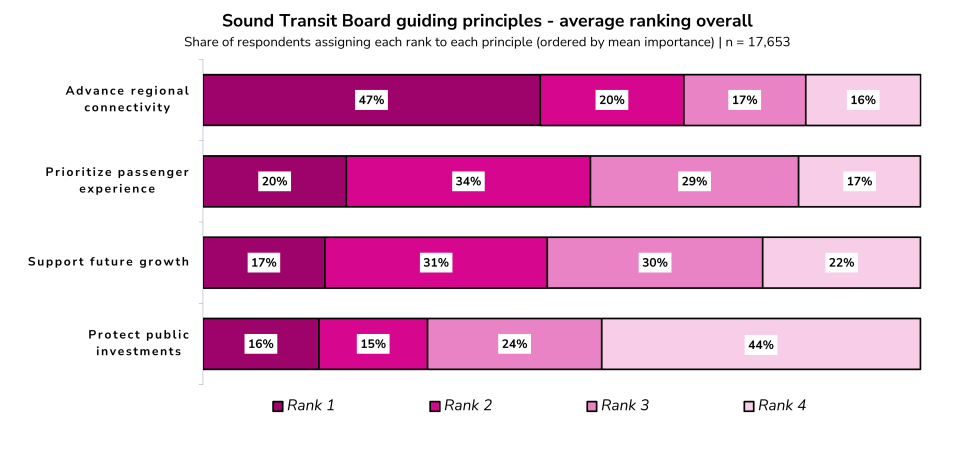
Prompt #1: “Sound Transit’s Board of Directors is using the following principles to guide decision-making to solve for these future financial challenges. Please rank each of the following from most important to least important.”
As shown in the pink bar chart below, respondents prioritized advancing regional connectivity and the rider experience as the core principles the Board should consider when it makes decisions.
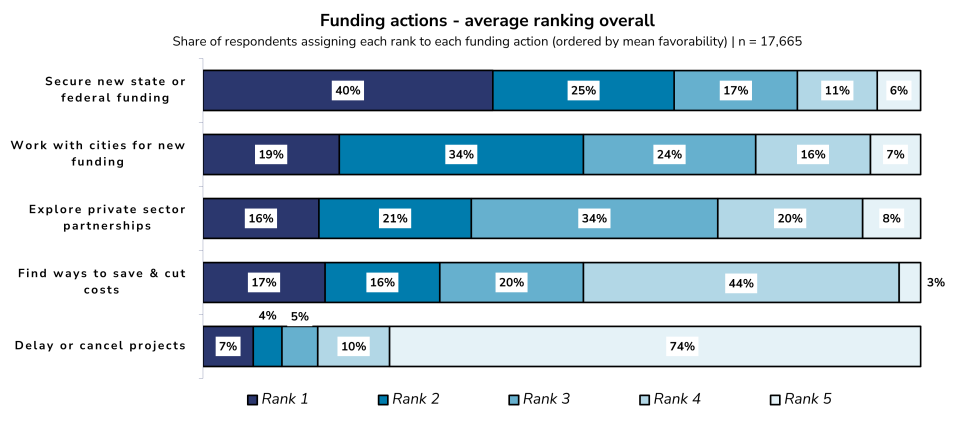
Prompt #2: “Delivering on the objectives of ST3 requires closing a $34.5 billion funding gap. Please rank each of the below actions from most favorable to least favorable.”
Ranked response to this question, illustrated in the blue bar chart below, shows respondents’ clear preference for finding new state or federal funding. This was the consistent top priority across all subareas, while delaying or canceling projects ranked lowest across all subareas.
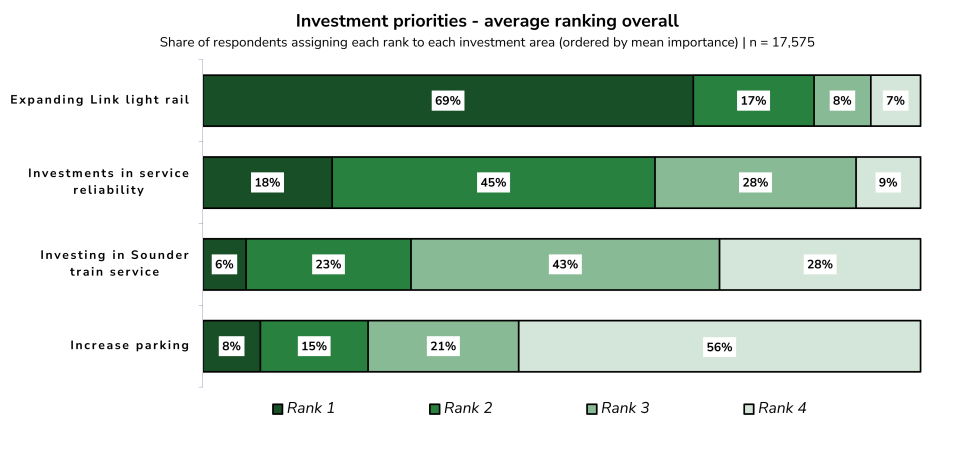
Prompt #3: “Even as Sound Transit is working to address future financial challenges, we are also thinking about how best to invest in our system. Please rank each of the below areas from most important to least important.”
As the green bar chart below shows, expanding Link light rail was the consistent top priority, while investments in service and reliability also ranked highly among respondents.
The second section of the online survey invited respondents to:
Name specific projects the agency should prioritize.
Share one thing they’d like the Sound Transit Board to know as its members begin to prioritize and make decisions.
Identify any topics related to the agency’s financial challenges on which they’d like to receive more information.
In addition to the shared regional priorities that emerged consistently through the ranked-choice responses, the open-ended questions showed communities’ support for their local projects and priorities.
Most-mentioned priority projects by subarea and ZIP code
Source: Open-ended priority-project responses.
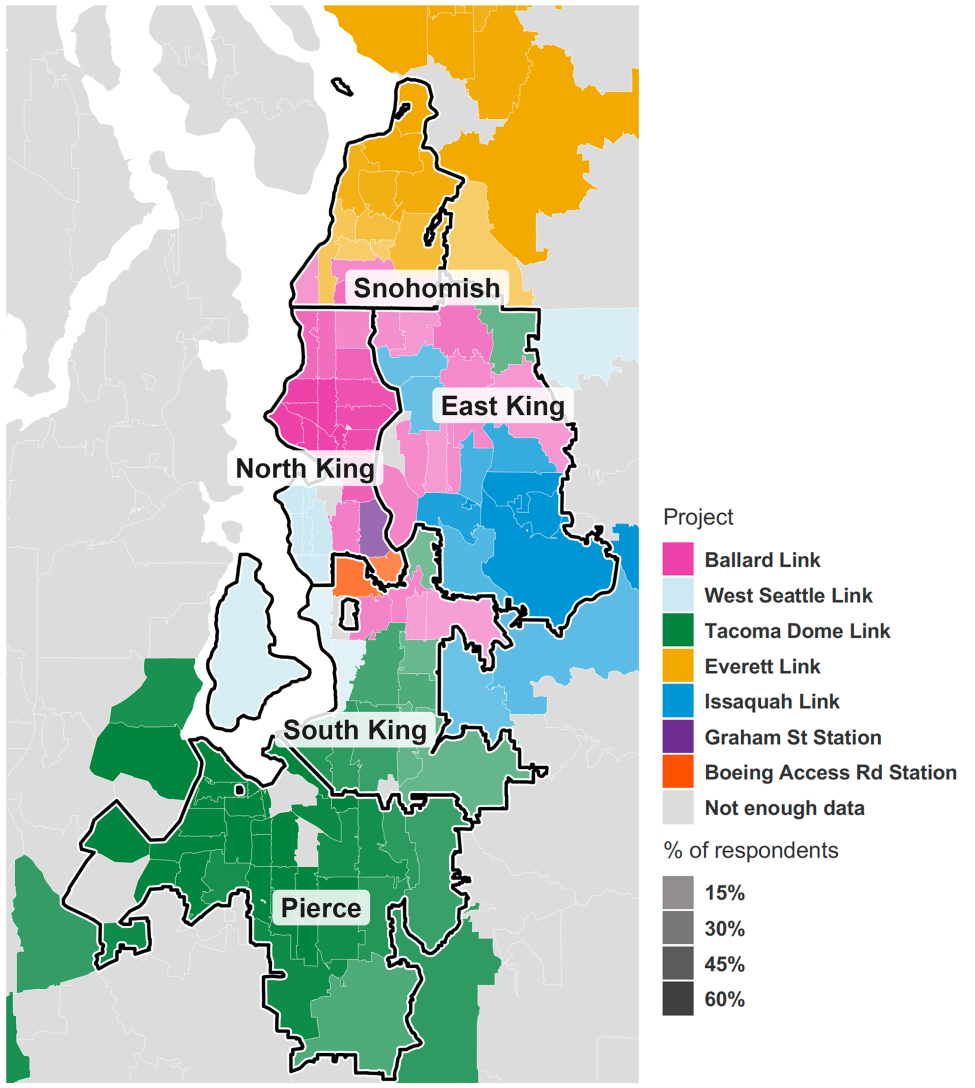
As shown in the map above, respondents from East King communities mentioned their support for South Kirkland–Issaquah Link; respondents from North King communities for West Seattle and Ballard; respondents from communities along the North/South King subarea border for Graham Street and Boeing Access Road stations; and Snohomish and Pierce for bringing light rail to Everett Station and the Tacoma Dome, respectively.
We also heard support for Sound Transit delivering the full ST3 program and using every tool available to do so. The majority said they preferred phasing, or deferrals over canceling projects. In addition, many members of the public requested meaningful, timely engagement and easy access to information.
For deeper analysis of Enterprise Initiative engagement, including subarea-specific feedback and survey methodology, check out our Engagement Summary Report.
Next steps
Sound Transit Board members are considering the summary report ahead of the May 28 meeting, where they’re scheduled to take action to update the ST3 System Plan.
This public feedback will supplement technical and financial analyses to support durable, equitable decisions and ultimately help Sound Transit’s staff and Board deliver an affordable Long Range Financial Plan in the months ahead.
But engagement doesn’t stop here; we’ll continue seeking public and community partner feedback as projects and strategies advance, using input to inform the agency’s planning, delivery, and financial strategies.
Be sure to stay tuned to The Platform blog and Sound Transit’s social media channels for frequent updates as work continues, and sign up for email updates on the projects you care about most.