Your express stop for the latest Sound Transit news

Link operations and maintenance facilities take center stage
Crucial to Sound Transit’s growing light rail network, these modern facilities are essential to keeping Link trains moving safely and reliably.
Sound Transit’s voter-approved expansion, the largest in the country, will build our network into a five-line light rail system with 116 miles of service and more than 80 stations across three counties.
That means nearly doubling the size of the Link network you know today — and dramatically expanding our fleet of electric light rail vehicles.
How will we store, clean, maintain, and deploy so many Link trains?
By also doubling our operations and maintenance facilities, or OMFs.
Today, the regional network relies on two OMFs to support service on the Link 1 and 2 Lines: OMF Central in Seattle’s SODO district, which opened when light rail service began in July 2009, and OMF East in Bellevue’s Spring District, which opened in May 2021 ahead of 2 Line service across Lake Washington. (Tacoma’s T Line has its own OMF as well for streetcar service.)
And as part of our ST3 expansion, Sound Transit is advancing plans for two new OMFs. These facilities will support the growing Link light rail system and create more than 1,000 new high-skill living-wage jobs in Snohomish and South King counties.
OMF South in Federal Way is in the final design phase, and we expect construction to begin next year. This facility will support expanding Link service across the region, including the future Tacoma and West Seattle extensions.
OMF North, currently in the planning phase, will be located in southwest Everett. Its support for regionwide service will include Sound Transit’s longest light rail expansion project, the 16-mile Everett Link Extension.
Together, all four facilities will create a regional network that will support Link service for generations to come.
Crucial to your ride
OMFs play a fundamental role in ensuring frequent and reliable Link service, and in Sound Transit’s commitment to a safe, clean, and welcoming ride.
“Every reliable trip begins with work our riders may never see,” says Executive Director of Rail Operations Ben Marx, who leads rail modal services for Sound Transit.
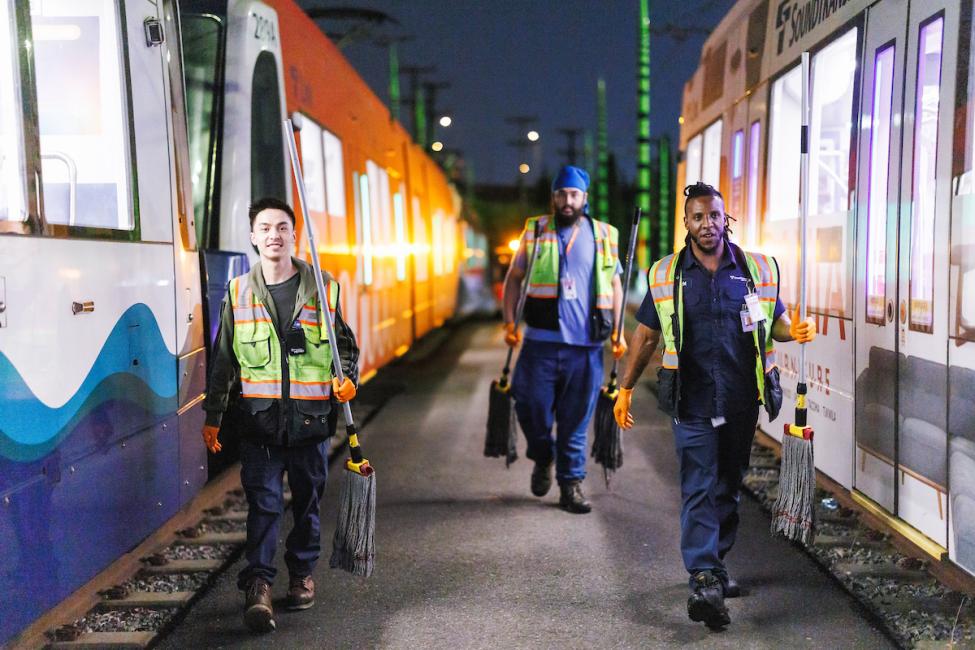
Behind the scenes at OMF Central and East, skilled technicians tune up, repair, and test Sound Transit’s electric light rail fleet daily. Every night, maintenance teams also sweep, mop, and scrub light rail vehicles, in addition to monthly deep cleans that include steam washing.
Watch the video: 30 seconds of ‘oddly satisfying’ soaping, whirring, rinsing, and buffing.
In addition to providing crucial cleaning and maintenance, OMFs support riders in real time by facilitating nimble service.
If crowds surge after a big event or if a train needs to be pulled out of service for immediate cleaning or repair, OMFs can deploy extra trains into service to meet demand.
“I’m grateful for the team members at our OMFs who provide the maintenance and support that keep our service running every day,” Marx says. “From preparing trains for daily service to coordinating with the Link Control Center to deploy additional trains for high-demand events, their work is essential. We simply could not deliver the service our riders depend on without their skill, care, and commitment — 24 hours a day, 365 days a year. They deserve our recognition and appreciation.”
To keep these reserve trains at the ready and to store light rail vehicles overnight when they’re out of service, an OMF needs several acres of rail yard space — and we’ll need much more of that in order to expand our fleet and launch Link service to Everett, Tacoma, and other communities across the region.
The design for OMF South includes about 66 acres, or the equivalent of 45 to 50 football fields. When it opens, it will be the only OMF capable of receiving our new Series 3 light rail vehicles, which will be roughly double the length of our current ones.
Watch the video: See how new trains are delivered to an OMF.
“OMF South will include a dedicated test track, giving Sound Transit a capability that our existing facilities don’t have,” explains Executive Project Director Eza Agoes, who leads the delivery teams for both South and North.
At roughly one mile long, the test track will allow maintenance and operations crews to test trains at full speed on site, without having to rely on the short overnight windows of time when passenger service is suspended to conduct testing on the active Link alignment.
“This feature will give our operations teams a dedicated place to test trains more safely and efficiently at OMF South,” Agoes adds. “It will improve the reliability of Link service across the region.”
OMF North is likely to require 80–100 acres near the light rail alignment, which will operate as the Link 3 Line when it reaches Everett. This includes the land needed for the facility itself, as well as construction and potential mitigation needs.
Learn more about OMF North: Review the Draft Environmental Impact Statement and share your comments on several alternatives for site location by Nov. 2.
Like our current facilities, both future OMFs will have maintenance bays for cleaning and repairs. They’ll also include “maintenance-of-way” buildings to maintain and store parts for the light rail guideway, including tracks, train signals, and other infrastructure.
Having these items on hand means more efficient upgrades and repairs when needed, ultimately creating more reliable service regionwide.

Fourth grade students from Bellevue Elementary took a behind-the-scenes field trip at OMF East to meet Sound Transit employees and learn about safety around trains.

The train yard at OMF Central in Seattle’s SODO neighborhood features artwork called “Safety Spires,” by Norie Sato and Dan Corson. Through color and a simple pattern, Sato and Corson transformed the facility’s overhead catenary system poles into a collection of horsetail reeds.

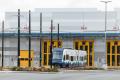
The 160,000-square-foot OMF Central in SODO includes nine service bays, a repair center, and automated wash-bays like an oversized car wash facility.

Each Link OMF creates hundreds of permanent high-skilled, living wage jobs.

The LEED Gold-certified OMF East in Bellevue opened in 2021. The facility includes rooftop solar panels to offset energy use, a water capture system, and public art along a popular public bike path.

Sound Transit’s expert technicians and maintenance teams work 24 hours a day, 365 days a year to ensure safe, clean, and reliable Link service.


Great jobs and innovative opportunities
Beyond the key role OMFs play in supporting Link service, they also benefit the larger community.
Far from the noisy, dirty maintenance yards of the past, Sound Transit’s OMFs are centers of sustainability and innovation that create thousands of great jobs across the region.
The future OMF South, which is advancing toward major construction beginning in mid-2027, will generate more than 4 million construction labor hours.
And once a facility opens, it creates hundreds more permanent jobs.
In partnership with King County Metro and building upon existing apprenticeship and workforce training programs, OMF South will create more than 600 high-skill living-wage jobs in South King County when it opens — currently forecasted for 2032.
In Snohomish County, OMF North will support another 450+ roles. It’s scheduled to open ahead of Link service to SW Everett Industrial Center (in 2037) and downtown Everett (in 2041).
But OMFs aren’t only a boon for the traditional workforce. They can also support environmental stewardship and community development.
OMF East in Bellevue is a glowing example, with its 100-kilowatt solar rooftop to offset energy use, a capture system to filter and reuse water again and again, and vibrant 30-foot-tall public art along a popular public bike path.
As former CEO Peter Rogoff was fond of saying when Sound Transit was planning the LEED Gold-certified facility, “This is not your grandparents’ train yard.”
The city of Bellevue and Sound Transit seized on the opportunity for transit-oriented development to create a mixed-use urban oasis on the site of an old rail spur and car dealership carwash.
Notably, there’s now housing nestled against this OMF: two separate buildings (more than 250,000 square feet) for 234 affordable apartments for individuals and families. Market rate housing and commercial development is slated for the rest of the site.
“OMF South and OMF North build on the sustainability approach we’ve established at OMF East,” Agoes says. “Both facilities will be designed to LEED Gold standards and will incorporate environmental mitigation, such as new wetland creation and existing wetland preservation and enhancement, as well as welcoming public spaces. These features are an important part of how we’re designing facilities that will serve our communities for generations to come.”
While OMFs do the behind-the-scenes work of keeping our service safe, clean, and reliable, they’ve also become front-and-center showpieces of our region’s transformational transit system.