Your express stop for the latest Sound Transit news

Sound Move at 30: The plan that put regional transit in motion
Thirty years ago, voters approved a plan that would help reshape how the Puget Sound region gets around.
That plan, called Sound Move, laid the groundwork for the regional transit system Sound Transit continues to build today.
For the Sound Move anniversary, we're celebrating all the places we've been – and where we're going next.
A regional vision takes shape
The path to Sound Move wasn't a straight one.In the 1960s and 1970s, regional leaders made several attempts to secure funding for a regional rail system. Proposals under the Forward Thrust initiative failed to win the necessary voter support in 1968 and 1970.
It would take more than two decades for regional rail transit to return to the ballot.
In November 1996, voters in Snohomish, King, and Pierce counties approved a $3.9 billion, 10-year plan to build a regional transit network.
The vote marked a turning point for a region that had spent decades trying to make regional rail transit a reality. It set in motion 30 years of planning, investment, and expansion that have fundamentally changed how people travel, work, and explore the Puget Sound region.
Today, Sound Move's original vision lives on in the transit system millions of people use to get where they need to go.
Sound Move gave the newly formed Central Puget Sound Regional Transit Authority the funding to begin building a high-capacity transit network. The plan included three main types of service designed to connect communities and major destinations across the region:
Light rail: A new rail line connecting the Sea-Tac Airport area with downtown Seattle and the University of Washington, with additional service envisioned as the system expanded.
Commuter rail: Sounder trains connecting communities north and south of Seattle, including Everett, Tacoma, and Lakewood.
Express buses: Regional routes connecting major population and employment centers, supported by transit centers, park-and-ride facilities, and highway access improvements.
The goal was bigger than adding new ways to get from point A to point B. It was about creating a connected regional network that could serve a growing population and give people more options for reaching jobs, schools, neighborhoods, and destinations around the Puget Sound region.
In 1997, the agency adopted the public-facing name Sound Transit. The work of turning the voter-approved plan into reality was underway.
From a ballot measure to everyday service
The first Sound Transit services launched in 1999, just three years after voters approved Sound Move.
ST Express buses began operating in September of that year, connecting communities across the three-county region. In 2000, Sounder commuter rail carried its first passengers between Tacoma and Seattle.
In 2003, Tacoma Link light rail (now called the T Line) service launched in downtown Tacoma, while Sounder service expanded north of Seattle. Then came an even bigger milestone: Central Link light rail opened in 2009, connecting downtown Seattle with Tukwila International Boulevard. Later that year, service extended to Sea-Tac Airport.
What began as a regional plan was becoming part of everyday life. People could travel farther across the region using a growing network of buses and trains, with more connections and destinations to come.
Building on the original vision
Sound Move established the foundation, but the region's transit needs didn't stand still.
As communities grew and travel patterns changed, Sound Transit continued planning for a more extensive regional network. Voters approved two additional funding measures that built on the original commitment.
In 2008, voters approved Sound Transit 2 (ST2), funding another phase of regional transit expansion. The plan supported additional light rail, commuter rail, and express bus investments, bringing service to more communities and destinations.
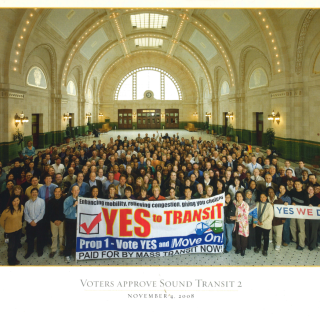
Then, in 2016, voters approved Sound Transit 3 (ST3), setting the stage for an even larger expansion. ST3 supports new light rail connections, three new Stride bus rapid transit routes, and commuter rail investments designed to connect more of the region.
Each plan built on the investments that came before it, adding new projects, destinations and connections while moving toward a more comprehensive regional transit network.
The results are visible across the region today. Link light rail now connects communities from Lynnwood to Federal Way, with connections across Lake Washington to the Eastside. Sounder serves riders traveling between Everett and Seattle, as well as Seattle and Lakewood. ST Express buses continue connecting communities throughout the three-county region.
And as the system has grown, so too has ridership.
In March 2026, the opening of the 2 Line's Crosslake Connection unlocked a long-awaited new transit option between Seattle and the Eastside. Within a month, Link promptly became the highest-ridership light rail system in the country, surpassing systems in Los Angeles, Boston, San Diego and San Francisco.
This anniversary represents a remarkable milestone for a region that was still working to get its first regional rail system funded just 30 years ago.
A region transformed — and what's next
The Puget Sound region of 2026 is not the same place it was in 1996.
Seattle, Bellevue, Tacoma and Everett have all grown, and the communities around them have changed alongside new jobs, neighborhoods, destinations and opportunities. The need for reliable connections across the region has only increased.
| City | 1995 | 2025 |
| Seattle | 532,900 | 816,600 |
| Bellevue | 102,000 | 158,000 |
| Tacoma | 184,500 | 228,400 |
| Everett | 79,180 | 114,700 |
Sources: Washington State population estimates and 2025 Office of Financial Management estimates. Figures are rounded.
Transit has fundamentally changed what's possible for people living here. A trip to work, a visit with friends, a night out or an adventure in a neighboring city can look very different when there are more convenient and affordable ways to get there.
And the next 30 years will bring even more change. The investments made through ST3 will continue expanding the regional network, connecting more communities and giving future generations more options for how they live, work and travel.
Sound Move was an ambitious commitment to a different future for the Puget Sound region. Thirty years later, that commitment is visible in the trains, buses, stations and connections that have become part of everyday life.