Your express stop for the latest Sound Transit news

A summer update on the West Seattle Link Extension
Find out how work has been advancing, where we’re applying cost savings, and how those changes will influence the project’s timeline.
Since Sound Transit’s Board of Directors adopted an updated ST3 System Plan in May to bring the agency’s long-term financial outlook into balance, we’ve been focused on advancing all fully funded and partially funded projects.
The West Seattle Link Extension, which will add 3.9 miles of service from SODO to Alaska Junction, remains the ST3 light rail extension furthest along in project development.
As a direct result of the Board’s work to update the system plan and ensure that we stay on track to deliver this important investment, the West Seattle project has been moving forward with several key actions this summer:
In June, the Board authorized final design contracts to fully fund that phase of the project and lock in cost savings identified by the project team.
In August, we anticipate Board actions authorizing the acquisition of properties needed to construct the project and appropriating funds to purchase properties, support relocations, and advance construction planning.
This winter, the project will bring on construction management services in advance of major construction contracts that will be awarded in 2027 to build the bridge, tunnel, guideways, and stations included in the project.
With these recent and upcoming Board actions, we’re making meaningful progress to deliver the West Seattle Link Extension.
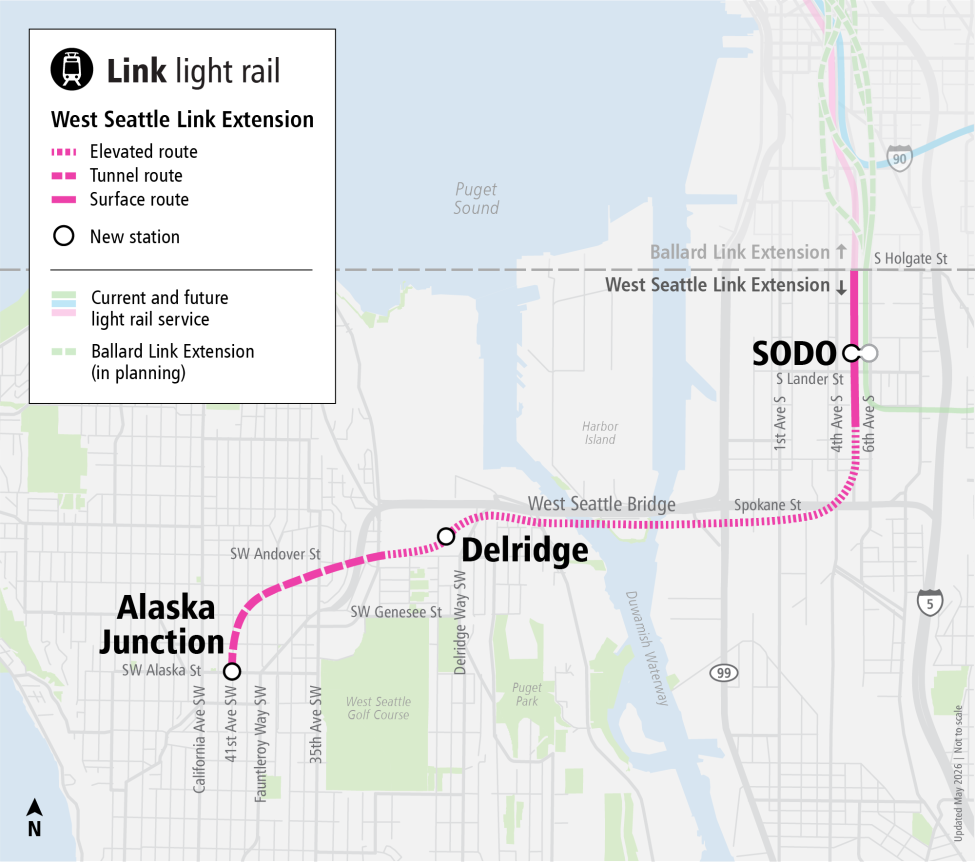
West Seattle schedule update
Following the ST3 System Plan Update in May, the agency completed a project timeline review. As staff shared at today’s Board System Expansion Committee meeting, the updated timeline for starting service is now 2035.
This shift results from two primary factors:
Cost-savings work: In late 2024, when we reported much higher than expected costs for the West Seattle project, the Board directed the agency to undertake a comprehensive cost-savings workplan.
This work, coupled with the Enterprise Initiative — Sound Transit’s agencywide effort to address a projected $35 billion dollar funding gap over the next quarter century — meant the West Seattle project was unable to fully advance its final design, property acquisition, and right-of-way phases until there was an updated and affordable ST3 System Plan.
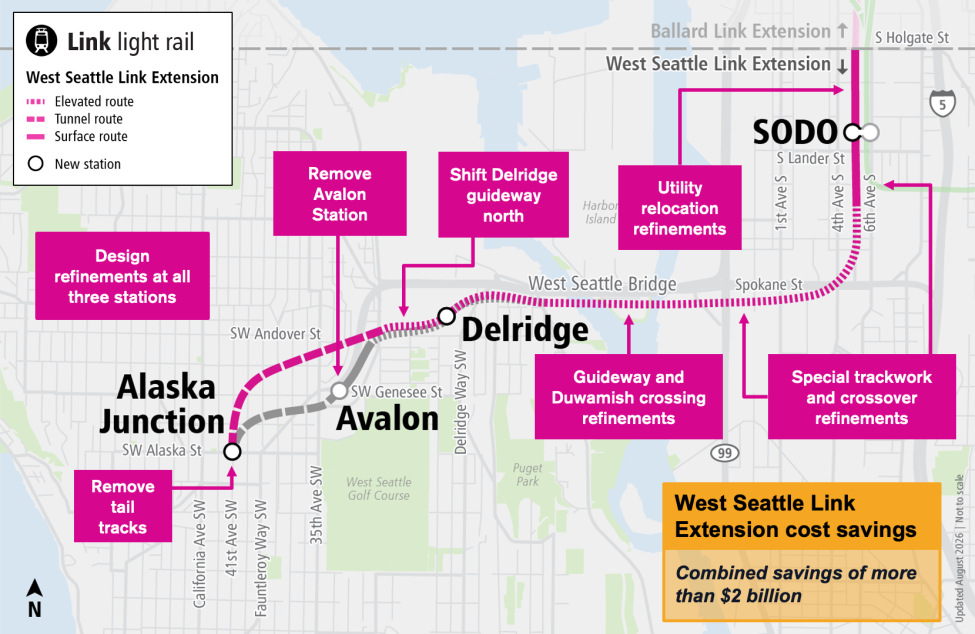
This critical work was a success, however. During the cost-savings exercise, the project team identified more than $2 billion in cost savings to drive down overall project cost, reduce impacts, and maintain high-quality rider experience on the future extension.
Refined construction timelines: While pursuing cost savings, the project team also scrutinized previous construction schedules, honing focus based on the Board-selected project to be built, established in fall 2024.
Through this effort, we determined that the complexity of building a new light rail-only crossing of the Duwamish River would require more time in the construction phase.
Together, these factors add approximately two to three years to the overall schedule and have been verified by both the project team and an independent, third-party review of the project schedule.
Though we know this shift is difficult news to folks who are eagerly awaiting light rail access in their communities, it represents a realistic delivery timeline that the agency can confidently stand behind.
Most importantly, it gives Sound Transit, our partners, and residents a clear timeline as we move the project forward.
Reducing community impacts in SODO
The SODO segment of the West Seattle project — one of the more complicated sections of the alignment — is seeing positive developments as design advances.
This segment requires relocating a major piece of Seattle City Light infrastructure: 230 kilovolt transmission lines, which are akin to electrical superhighways.
With the support of elected leaders and community stakeholders, the project team collaborated closely with the City of Seattle to find a better solution to this complex technical work.
We’re pleased to share that we have agreed on a technical solution to relocate the 230kV transmission line within the light rail corridor, avoiding the need for construction on 6th Avenue S that was part of the previous plan.
This design refinement to reduce construction effects in SODO follows progress reported in March 2026 to lessen community impacts in Delridge and Alaska Junction.
Taken together, this work has produced a project that is more affordable, has fewer community impacts, and is better positioned for successful delivery than it was just two years ago.
Next steps on West Seattle
Sound Transit is committed to delivering the West Seattle Link Extension while remaining disciplined about finding cost and schedule savings and transparently sharing information with you about our progress.
Be sure to sign up for project updates, follow Sound Transit on social media, and stay tuned to the Platform blog.