Fare gates pilot program
Overview
In August 2026, Sound Transit launched a multi-year pilot program to install and test fare gates at several light rail stations throughout the region.
Rolling out in phases, the full pilot program is designed to run through approximately 2034.
The initial phase of the pilot will include contracting with a vendor to manufacture, deliver, and install gates at up to 14 stations on both the 1 Line and 2 Line. Installation is currently targeted for around 2029–2030.
During this first stage, staff will also will focus on developing strategies for public engagement, accessibility design, fare media upgrades, and increasing access to more people who need a way to pay. Sound Transit will also focus on developing equity and evaluation frameworks for the pilot program, including clear metrics that capture critical issues.
-
Learn more in the June 2026 Faregate Assessment Report.
-
Board approves pilot program (August 2026)
-
Contracting, manufacturing, delivery, and installation.
Establish comprehensive Fare Gate Pilot Evaluation Framework for Board approval by end of 2027.
Engage the public and key interest holders — including passengers with disabilities, riders who qualify for reduced fares, and youth — to inform decision making.
Develop ADA and accessible design strategies.
Explore technology solutions for upgrading fare media (paper tickets, youth passes, etc.) and expand enrollment and access.
Update staffing model, including Fare Ambassadors.
-
Fare gates launch (2029/2030)
-
Testing, feedback, and evaluation (2030-2034)
Once gates are installed and testing begins, the Sound Transit Board will review performance after approximately one, three, and five years. At these decision points, the Board will consider whether to maintain, modify, expand, or discontinue the pilot program.
Any future actions to retrofit fare gates systemwide or permanently change fare policy would require separate Board authorization.
What riders can expect
While installing fare gates will require a behavioral shift, they’ll also help clarify when and where passengers need to pay for their ride.
The pilot program creates a long runway to prepare for this transition around 2029–2030.
Currently, every Link rider is required to pay (while youth 18 and under, who ride free, are encouraged to get and tap an ORCA Youth Card). Anyone within Fare Paid Zones — marked with bright yellow signage and tactile strips in stations and on platforms — must show proof of payment if asked by Fare Ambassadors.
This system, however, has resulted in low fare compliance levels in recent years.
Future fare gates will require every rider to provide proof of payment to enter and exit platforms at any station where gates are installed.
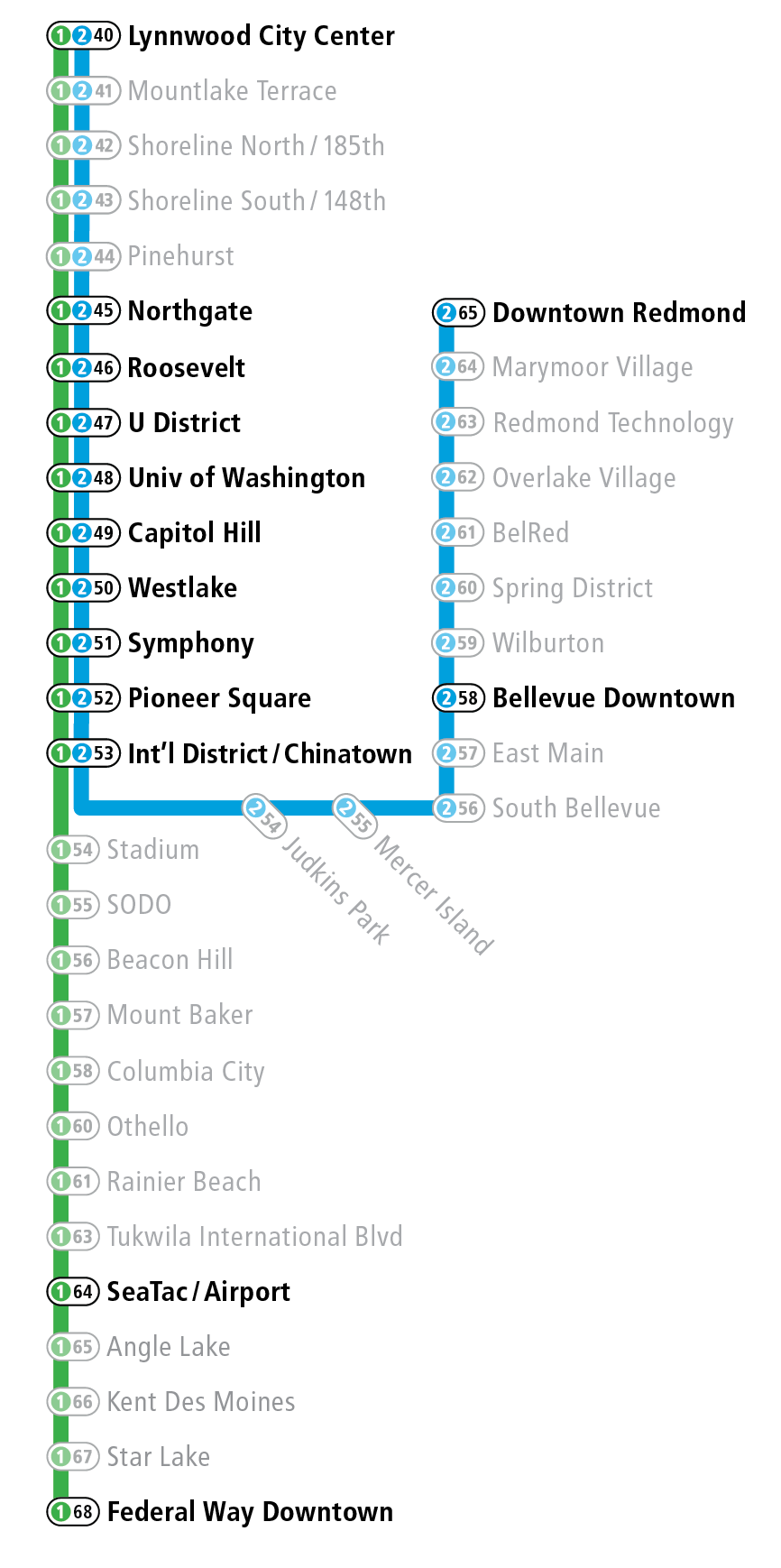
Sound Transit has identified 14 stations for initial fare gate installation as part of the pilot.
That list includes nine stations in the system’s core serving both the 1 and 2 Lines: International District/Chinatown, Pioneer Square, Symphony, Westlake, Capitol Hill, University of Washington, U District, Roosevelt, and Northgate stations.
It also includes line termini stations Lynnwood City Center, Downtown Redmond, and Federal Way Downtown, plus SeaTac/Airport Station and Bellevue Downtown Station.
Frequently asked questions
Why doesn’t the Link system currently have fare gates, and why change now?
Many public transit systems across the country — including in cities like Denver, Dallas, Minneapolis, and Portland — are designed without turnstiles or fare gates. This approach is common for systems with street-level (or “at-grade”) stations where riders might be tempted to take shortcuts to avoid fare gates, creating unsafe situations with trains and motor vehicle traffic.
This was the case when Link first opened in 2009, as at-grade stations comprised much of the initial system between Westlake and Tukwila. In addition, light rail and buses shared the downtown Seattle tunnel at that time, making fare gates impractical at those stations.
Since then, Sound Transit’s regional system and ridership have grown exponentially, to the point that fare gates now make financial sense when balancing ridership and cost.
In August 2026, the Sound Transit Board authorized the pilot program in response to a newly commissioned study showing that fare gates would provide a positive return on investment after two to three years. Peer agencies that have implemented fare gates have also benefited from meaningful impacts to fare recovery rate, passenger experience, staff safety and effectiveness, maintenance needs, and operational performance.
What will the pilot program cost?
Sound Transit estimates the entire cost of the pilot, including the construction, to be about $87 million.
Preliminary estimates show a breakeven point for capital and operational expenses at around two to three years after fare gate implementation.
This model includes:
The cost of installation at each recommended station.
Ongoing maintenance costs.
Staffing costs.
Ridership and fare compliance projections.
It does not include any potential savings from improved security or reduced maintenance. These potential related outcomes came up often during Sound Transit’s conversations with peer agencies that have adopted fare gates.
Sound Transit’s preliminary assessment, which models three different scenarios, estimates that fare gates can ultimately increase net revenues from fares by $32.8 million to $82.7 million per year.
Why did Sound Transit choose these 14 stations for the pilot?
Sound Transit completed an implementation study in 2026 to inform the pilot project. That study used a process to identify an initial set of stations that maximize benefits to the system. Specifically, that included three levels of consideration:
First, highest-traffic stations. About 85% of riders use 10 main stations, and terminus stations are major hubs where riders transfer to or from buses or other modes.
Next, design feasibility. Some stations inherently pose greater challenges for a retrofit, for example: at-grade station safety, electrical access, or the need to build too much structure to protect the gates.
And finally, the cost to install at a station versus that station’s respective ridership.
Ultimately, the 14 stations identified for the pilot program offer the best potential return on investment.
How will Sound Transit mitigate physical accessibility challenges associated with fare gates?
Getting to the train should be easy and hassle-free, whether you’re walking, using a mobility device, or traveling with a stroller, bike, or luggage.
In the initial phase of the pilot program, staff will focus on developing and designing a fully accessible and ADA-compliant experience, informed by international best practices, lessons learned from peer agencies that have retrofitted fare gates, ongoing collaboration with local accessibility experts, and equitable public engagement.
What about challenges with fare media, like paper tickets, passes, or electronic payments?
Stage one of the pilot program includes work to ensure all fare media will work well with gates and that riders will have the support they need if challenges arise.
We’ll be exploring many aspects of the passenger experience through this process. That may include things like new digital solutions, updating paper tickets, and considerations for when people transfer from light rail to other modes.
As we develop these solutions, we’ll specifically focus on creating an easy experience for youth, diverse language groups, people with disabilities, riders who qualify for reduced fares, first-time riders, and people without ORCA cards.
The fare gates pilot program is designed to find equitable solutions to these and any other payment challenges that may arise through the process.
Sound Transit’s decisions around how to adapt fare media and distribute it more widely will be informed by what we hear from our passengers. Public engagement will be critical in developing a technology approach that provides easy and automated access to our system.
What will Fare Ambassadors do once fare gates are installed?
Fare Ambassadors will be an essential part of Sound Transit’s partially gated system. There are no proposed reductions to Fare Ambassador staffing associated with the fare gate pilot program.
Once fare gates are in place, however, Fare Ambassadors’ core responsibilities are likely to shift. Sound Transit estimates Fare Ambassadors will spend about 44% fewer work hours on fare compliance, and about 33% more time focused on passenger support.
Through public engagement and passenger experience mapping during the first stage of the pilot, Sound Transit will identify the best places, times, and methods for Fare Ambassadors to increase support across the system.
How can I get more information?
You can expect to hear more about the Fare Gates Pilot Program in the months ahead as Sound Transit begins public engagement. Bookmark this page or stay tuned to The Platform blog and social media for our email list sign-up, coming soon.
Questions in the meantime? Contact faregates@soundtransit.org.
How will Sound Transit measure pilot program success?
To ensure informed decision-making around whether to continue, modify, or expand the pilot, staff will present a comprehensive Fare Gate Pilot Evaluation Framework, including specific goals and metrics, for Board for approval by the end of 2027.
A range of factors will determine pilot program success, from fare compliance and return on investment to safety, maintenance, and frontline staff experience. Many aspects of the passenger experience will be critical as well, including physical accessibility, information accessibility, and fare media accessibility — particularly for youth, diverse language groups, people with disabilities, and riders who qualify for reduced fares.
If the pilot is ultimately deemed a success, the Sound Transit Board may consider future actions to implement fare gates systemwide or permanently change fare policy.